 Yanis
26d0f39986
Yanis
26d0f39986
Wires the React Native app to the vineye-admin backend so user accounts
and scans flow into the admin panel, and so a ban applied via the panel
takes effect on the device on the next app boot (or sooner on any
authenticated request).

Core
- Install expo-secure-store for storing the better-auth session token.
  Falls back to AsyncStorage on web/Expo Go where SecureStore is unavailable.
- New tokenStorage service with saveToken/getToken/removeToken and a
  stable per-install getDeviceId() (used to derive the deterministic
  password the backend signs sign-up/sign-in with).
- Extend the API client with apiPost(), automatic Bearer header attach,
  and a tiny pub/sub (authEvents) that emits 'unauthorized' on 401 and
  'banned' on 403 with banned: true. Handlers are global so any request
  can trigger logout or open the BannedModal.

Auth
- New services/api/auth.ts: syncUser (POST /auth/sync), fetchMe (GET
  /auth/me), signOutServer (POST /auth/sign-out, best-effort).
- types/auth.User now carries optional banned/bannedReason/role/xp/level
  hydrated from the backend.
- AuthContext.login is now async vs the backend; the server-side id
  replaces any locally-generated UUID so mobile and admin agree on the
  same User row. Hydration is optimistic from AsyncStorage (never blocks
  the splash on the network) and a background fetchMe picks up server
  ban changes. logout/resetAccount best-effort revoke the server session.
- AuthChoiceScreen surfaces sign-up failures through a toast instead of
  silently dropping the user into the app with no account.

Ban UX
- BannedModal: non-dismissible Tailwind modal with the bannedReason
  interpolated and a CTA that calls resetAccount. Mounted globally in
  RootNavigator and toggled by isBanned from AuthContext.
- Banned state is persisted alongside the User in AsyncStorage so the
  modal stays visible across restarts even when /auth/me is unreachable.

Scan sync
- New services/api/scans.pushScan() that maps the mobile ScanRecord to
  the backend body: confidence /100 (0-100 → 0-1 backend), diseaseSlug
  passthrough (server resolves to diseaseId), latitude/longitude direct,
  imageUrl always null (V1 keeps photos local-only), customName dropped
  (no column server-side, stays in AsyncStorage).
- useHistory.addScan now fires pushScan after the local save and ignores
  failures so the app stays usable offline.

i18n
- New keys auth.errors.network/signupFailed and auth.banned.{title,
  description,descriptionNoReason,cta}. The fr/en files also include
  scanner gallery placeholder keys from an adjacent feature WIP — not
  part of this commit's scope but bundled here to avoid splitting a
  small JSON.

Co-Authored-By: Claude Opus 4.7 (1M context) <noreply@anthropic.com>
|
||
|---|---|---|
| .claude | ||
| docs | ||
| venv | ||
| VinEye | ||
| vineye-admin | ||
| .gitignore | ||
| AGENTS.md | ||
| CLAUDE.md | ||
| package.json | ||
| pnpm-lock.yaml | ||
| PROJECT_SUMMARY.md | ||
| README.md | ||
Tensorflow Grapevine Disease Detection
Description
This project develops a mobile application for detecting diseases on grapevines using a Deep Learning model. The implementation leverages TensorFlow and Keras to build a CNN-based classifier for identifying three common diseases: Black Rot, ESA (Net Blight), and Leaf Blight.
📁 Dataset
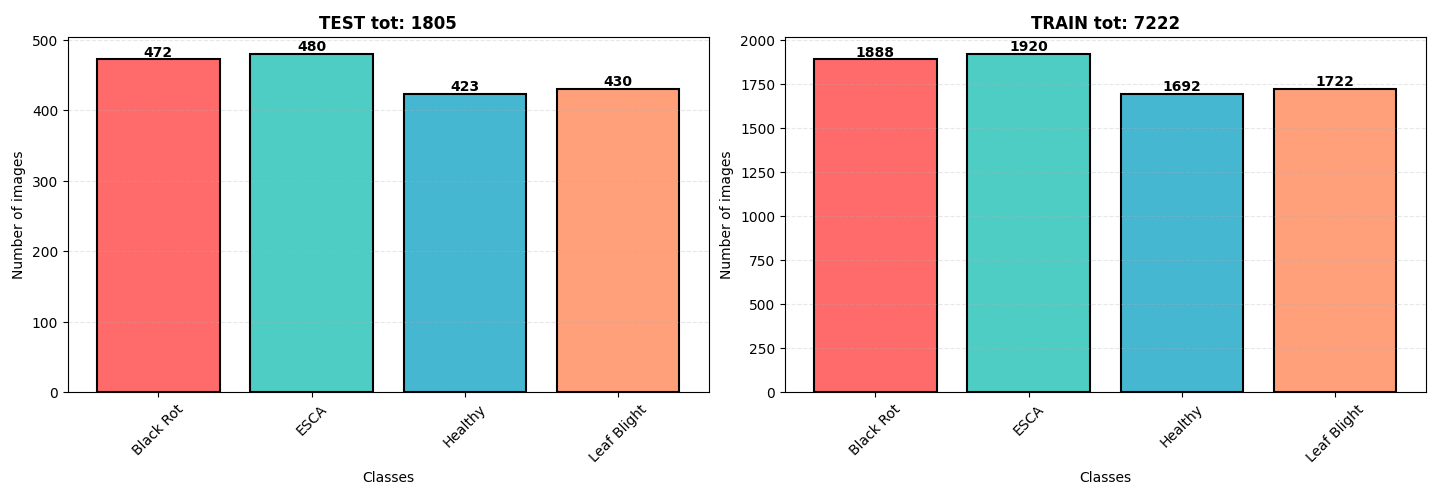
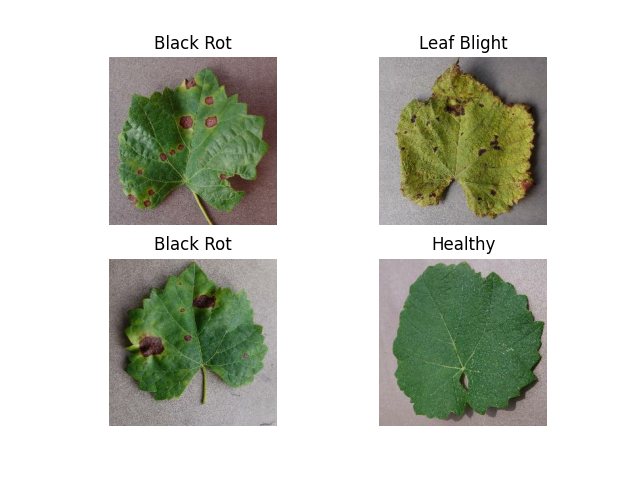
The dataset originates from Kaggle, containing 9,027 images of grapevine leaves. The diseases are categorized as:
- Black Rot
- ESCA (Net Blight)
- Leaf Blight
The dataset is well-balanced with a slight overrepresentation of ESCA and Black Rot. All images are in .jpeg format with dimensions 256x256 pixels.
📊 Model Architecture Selection
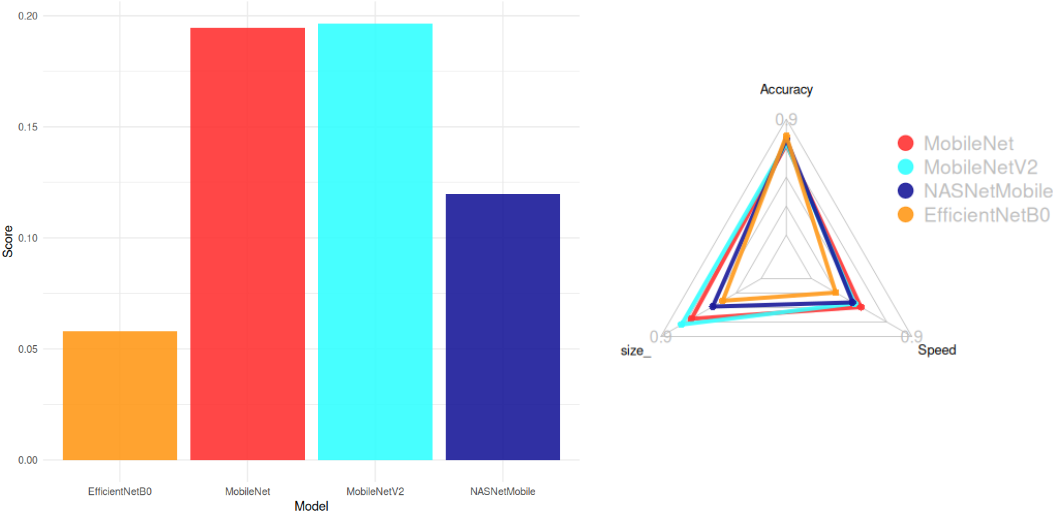
We evaluated pre-trained models from keras applications to balance accuracy, model size, and inference speed. The selection criteria included:
- Maximize accuracy
- Minimize size (1/size)
- Maximize CPU speed (1/CPU Time)
The score formula used for selection was:
Score = \frac{Accuracy}{Size . CPU Time}
Top Models (Score > 0.05):
- MobileNetV2 (Smallest: 14 MB, High Accuracy: 77%)
- MobileNet (Fastest: 22.6 ms)
- NASNetMobile
- EfficientNetB0
Conclusion:
MobileNetV2 was chosen for its optimal balance between accuracy, size, and speed.
🍇 Grapevine Diseases
Key Diseases:
- Black Rot
- ESCA (Net Blight)
- Leaf Blight
🤖 Model Structure
Architecture:
# Auto Stop
early_stopping = EarlyStopping(monitor="val_loss", min_delta=0.2, patience=10)

# Model
model = Sequential()
model.add(tf.keras.applications.MobileNetV2(
    input_shape=(IMG_HEIGHT, IMG_WIDTH, CHANNELS),
    include_top=False,
    weights='imagenet'
))
model.add(tf.keras.layers.GlobalAveragePooling2D())
model.add(tf.keras.layers.Dense(100, activation='relu'))
model.add(tf.keras.layers.Dense(100, activation='relu'))
model.add(tf.keras.layers.Dense(NUM_CLASSES, activation='softmax'))

optimizer = tf.keras.optimizers.Adam(learning_rate=LEARNING_RATE)

model.compile(
    optimizer=optimizer,
    loss=tf.keras.losses.SparseCategoricalCrossentropy(from_logits=True),
    metrics=['accuracy']
)
Parameters:
- Total params: 7.12M (27.17 MB)
- Trainable params: 2.36M (9.01 MB)
- Non-trainable params: 34.11K (133.25 KB)
🛠️ Training Details
- Batch Size: 32
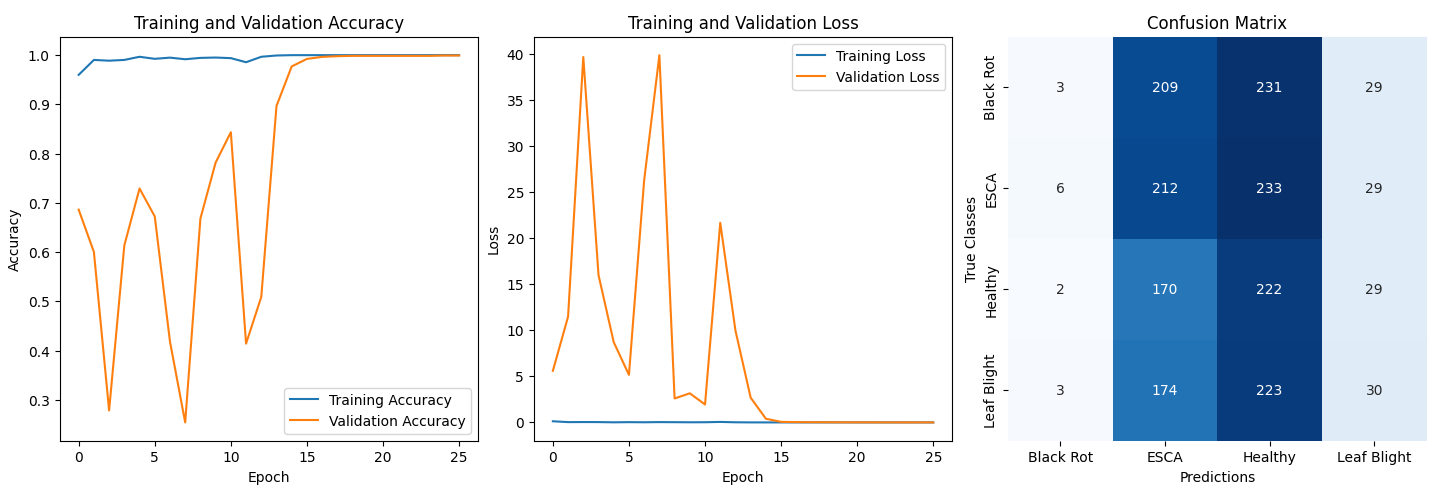
- Epochs: 100 (reduced to 25 via early stopping)
- Data Augmentation: Not used (insufficient improvement in accuracy)
- Normalization: Pixel values normalized to [0, 1]
📊 Results
Performance:
- Validation Accuracy: ~99.9%
- Confusion Matrix Analysis:
- Model biased toward ESCA and Healthy classes.
- Suspected causes:
- Original dataset imbalance
- Similar visual features across diseases
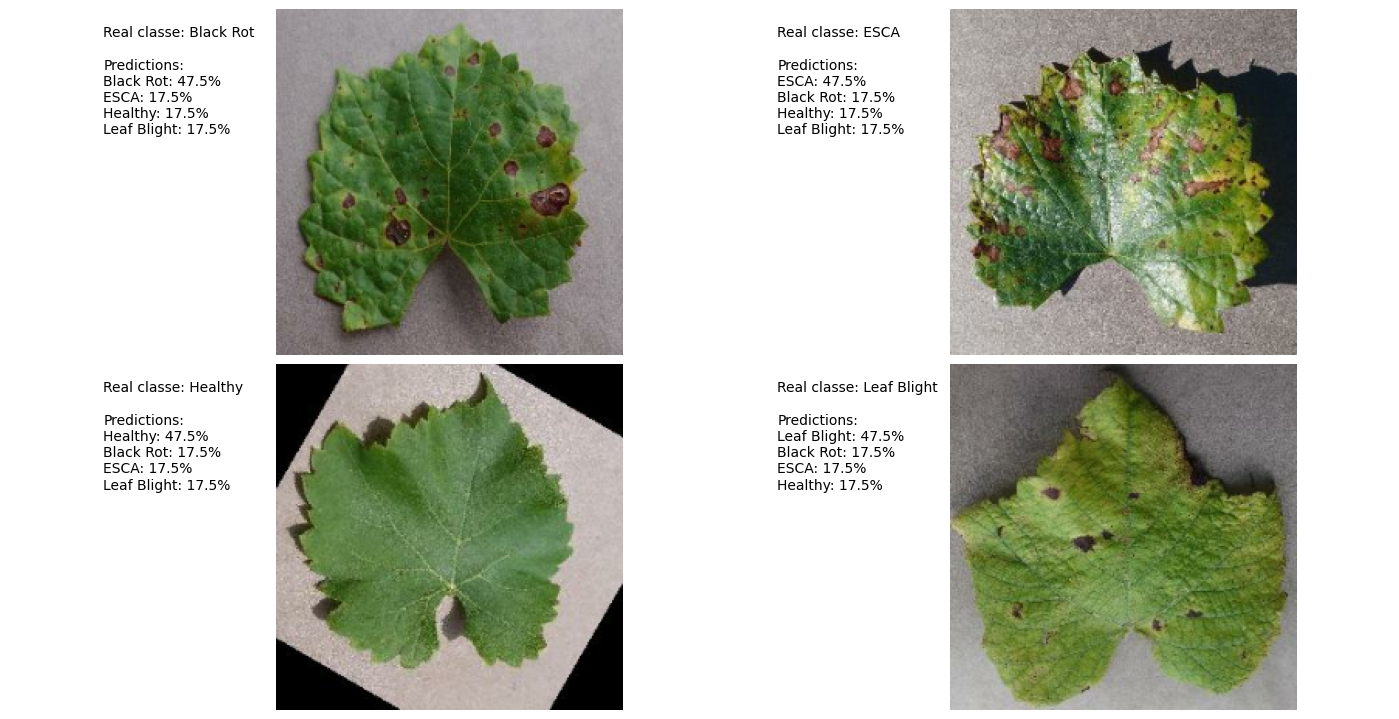
Prediction Example:
Attribution Mask:
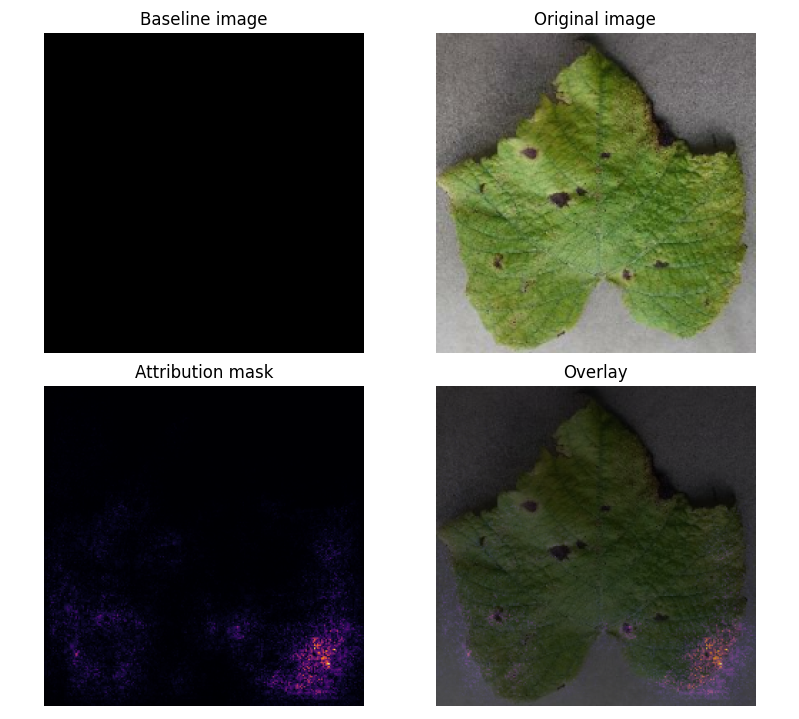
- Key Insight: Model focuses on leaf shape rather than disease-specific features (e.g., black spots).
📚 ressources:
https://www.kaggle.com/code/ahmedmsaber/grape-leafs-diseases-mobilenetv2-val-acc-99
https://www.tensorflow.org/tutorials/images/classification?hl=en
https://www.tensorflow.org/lite/convert?hl=en
https://www.tensorflow.org/tutorials/interpretability/integrated_gradients?hl=en
🤖AI(s) : deepseek-coder:6.7b | deepseek-r1:8b